
The Dog Socialisation Spectrum, Why Not Every Dog Is a Daycare Dog
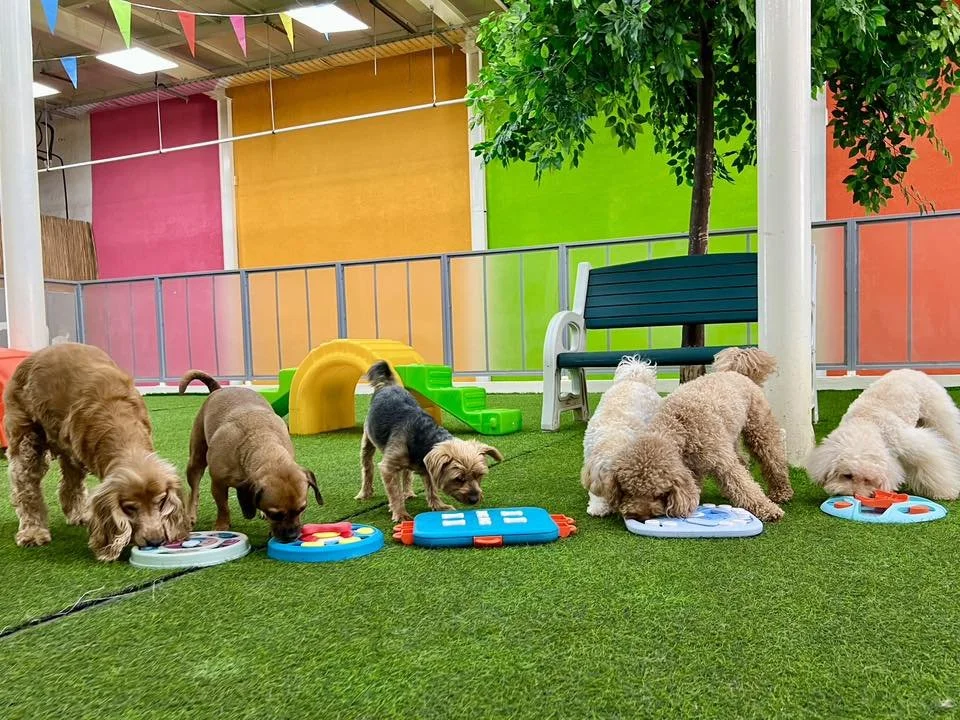
We talk about socialisation as if it is a single destination. A place all dogs are supposed to arrive at, where they happily play with any dog they meet, thrive in group settings, and generally love the chaos. But that is not how it works for dogs, any more than it works for people.
Dogs exist on a spectrum. Some are genuinely social. They light up in group play, they seek out new dogs, they come alive in a busy environment. Others are socially selective. They have their friends, they tolerate strangers, but they do not need a crowd to be happy. And some dogs are genuinely not group-suited. They find group environments stressful, they are better one-on-one, and putting them in a daycare setting is not enrichment. It is strain.
The problem is that an industry built on volume has very little incentive to tell you your dog might not need, or want, what they are selling. A facility charging per head per day does not benefit from admitting that your dog would be better off elsewhere. Fetch is built differently, and we think honesty about this makes for better dogs, better guardians, and frankly a better industry.
What the spectrum actually looks like
Research on canine social behaviour consistently shows that dogs vary significantly in their sociability. A 2022 systematic review of 29 socialisation studies confirmed stable individual differences in how dogs engage with other dogs, with some individuals consistently seeking interaction and others consistently avoiding or disengaging from it (Crump and Arnott, 2022). Breed-level studies show these differences have a significant heritable component, but individual variation within breeds is equally well-documented (Svartberg, 2006). These differences are not problems to be fixed. They are normal variation.
At the group-suited end of the spectrum you have dogs who seek social engagement, recover quickly from friction with other dogs, read social signals well, and arrive at group settings already ready to engage. These dogs tend to thrive in daycare. The environment gives them something they genuinely want.
In the middle you have socially selective dogs. They have preferred social partners, they can engage positively with compatible dogs in smaller or lower-intensity settings, but they find large groups or sustained social pressure effortful. These dogs may do well in daycare with the right structure, smaller group sizes, and careful matching. They need more assessment and more ongoing monitoring than the naturally group-suited dog.
At the other end you have dogs who find group environments genuinely aversive. The noise level, the inability to leave when they want to, the sustained presence of unfamiliar dogs, and the absence of their guardian all combine into something that is not fun. These dogs often cope well enough that their discomfort goes unnoticed. But coping is not the same as thriving.
How to tell the difference
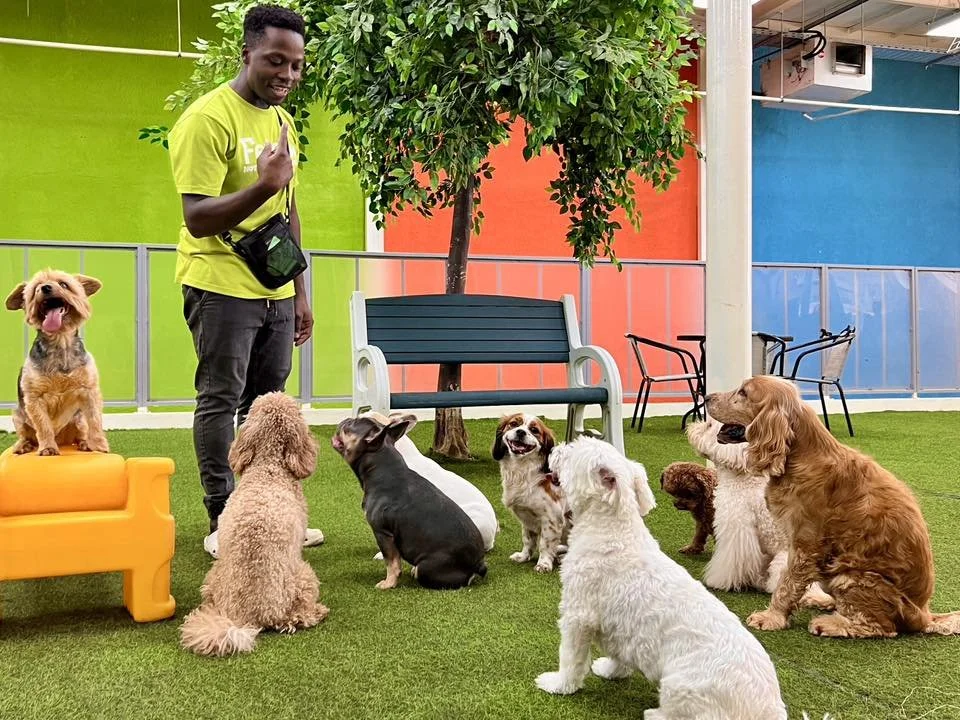
The signs guardians most commonly misread are exhaustion and compliance. A dog who comes home from daycare collapsed and sleeps through the evening is often interpreted as a dog who had a great day. But exhaustion from chronic over-arousal and stress looks identical to exhaustion from a genuinely good day. The way to tell the difference is in what comes the next morning.
A dog who had a good day comes back to baseline relatively quickly. They are themselves. A dog who spent the day in a state of sustained stress or over-arousal may be more reactive, more irritable, more clingy, or more shut-down the following day. Gastrointestinal sensitivity is also a well-documented physiological marker of chronic stress in dogs, with changes in cortisol linked to gut microbiome disruption in dogs showing stress-related behaviour (Tami and Gallagher, 2021).
Other signs worth paying attention to at drop-off: does your dog pull toward the entrance, or do they resist and need encouragement? A dog who is genuinely enthusiastic about their environment will show it. A dog who has learned to tolerate it will go along with it. That distinction matters.
What Fetch does about it
Every dog at Fetch goes through a mandatory acclimatisation period before joining the full programme. This is not a single trial day. It is a structured observational phase designed to give the team real data about how your dog experiences a group environment, whether the Fetch setting is genuinely the right fit, and what kind of support they might need.
Sometimes the answer is that daycare is great for them and they should join. Sometimes the answer is that Central Bark, guardian-present and lower-intensity, is a better starting point. Sometimes the answer is that group daycare is not the right environment for this dog at all, and we say that, directly, and talk through what would serve them better.
We have turned dogs away. We will continue to do it. Not because we do not want their business, but because putting a group-averse dog in a group environment is not care.
Want to know where your dog sits on the spectrum?
That is exactly what Fetch's acclimatisation assessment is designed to find out. No assumption that daycare is the right answer, no pressure either way. Join the waitlist and we will be in touch to arrange your dog's assessment.
References
Crump, A. and Arnott, G. (2022). Canine socialisation: a narrative systematic review. Animals, 12(21), 2895. https://doi.org/10.3390/ani12212895
Svartberg, K. (2006). Breed-typical behaviour in dogs: historical remnants or recent constructs? Applied Animal Behaviour Science, 96(3-4), pp. 293-313. https://doi.org/10.1016/j.applanim.2005.06.014
Tami, G. and Gallagher, A. (2021). How to evaluate and manage stress in dogs: a guide for veterinary specialists. Research in Veterinary Science, 139, pp. 219-229. https://doi.org/10.1016/j.rvsc.2021.07.019