
Why Long Weekends Are Actually Hard for Dogs, And What Good Daycare Does About It.
Dubai slows down over long weekends. Traffic clears, plans open up, and most people quietly exhale. Dogs, largely, do not share in this relief.
This isn't a character flaw. Dogs are routine animals in a way that runs much deeper than habit or preference. Their nervous systems are genuinely calibrated around predictability, consistent feeding times, consistent activity, consistent human presence. When that changes, even in ways that seem positive or neutral to us, they feel it.
Over Eid Al Adha, when guardians are travelling, visiting family, or simply off their usual schedule, the shape of a dog's day can shift significantly. For some dogs this lands fine. For others, particularly those who are already sensitive, under-socialised, or prone to anxiety, a disrupted week can tip them into a state of low-grade stress that their humans often don't recognise until it's already taken hold.
Good daycare doesn't just fill the hours. It holds the structure.
What structure actually means for a dog
Enrichment-based daycare operates on a schedule that mirrors the rhythm a dog actually needs: active periods, rest periods, 1-to-1 engagement, group interaction, and genuine downtime. Not because it's a nice idea, but because that rhythm maps onto canine physiology. Dogs don't regulate arousal the way humans do. They need the environment to do some of that work for them.
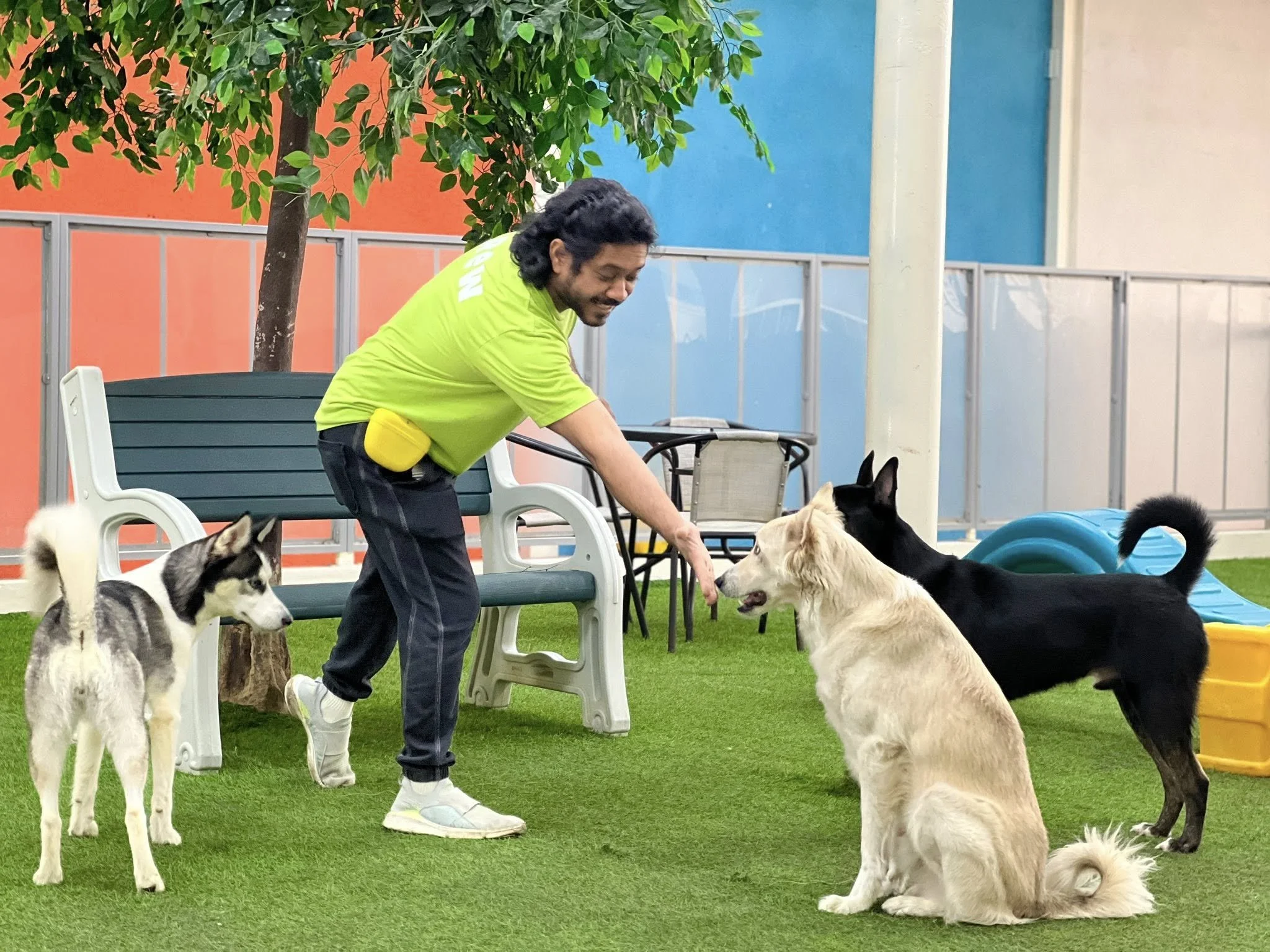
This is why rest is as important as play in a well-run daycare. A dog who moves through a day that includes structured activity and genuine rest, not rest as a consequence, but rest as a valued and expected part of the day, in a space they already know and associate with good things, returns home in a meaningfully different state than a dog who's been stimulated continuously for six hours.
Research supports this consistently. Chronic over-stimulation in group care settings elevates stress hormones, disrupts sleep quality, and can contribute to reactivity over time (Muns Vila et al., 2024; Cobb et al., 2016). Rest is not a gap in the programme. It is the programme.
The familiarity factor
There's a real difference between a dog who goes to daycare and a dog who knows daycare. The first is managing novelty on arrival. The second is walking into somewhere familiar, familiar smells, familiar people, familiar rhythms, and settling into a day they've had before.
That familiarity extends to every part of the environment. Including the quieter parts. A dog who has rested in a specific space as a regular, pleasant part of their day, where rest is associated with calm and good things, rest treats included, will find that space straightforward during a long weekend away from home. A dog for whom that space only ever signals something went wrong will carry that association in with them every time.
This is why any facility worth considering will not take a dog for their first daycare visit on a long weekend. The groundwork needs to happen before. The dog needs to know the space, know the people, know the rhythm. Then the long weekend becomes an extension of something familiar rather than an introduction to something new.
Over-arousal versus misbehaviour
Group daycare gets energetic. Dogs are social, they're responsive to each other, and arousal is contagious in ways that can build quickly. A dog who tips into over-arousal in that environment is not misbehaving. They're responding exactly as their nervous system is designed to respond to sustained social stimulation.
What happens next matters enormously. A facility that treats over-arousal as a behavioural problem will respond to it as one. A facility that understands it as a physiological state will respond differently, with calm redirection, nose work, and rest in a familiar space, giving the nervous system the opportunity to regulate naturally before the dog returns to the group.
The language a facility uses here tells you a lot. Time-out implies consequence. Time-in implies understanding. It's a small distinction in phrasing and a significant one in practice.
What to actually do over this Eid
If your dog already attends enrichment daycare regularly, a long weekend is genuinely good for them. The structure holds, the familiar faces are there, and the day is built around their needs rather than whatever disruption is happening outside.
If your dog hasn't been to daycare before, a long weekend is not the moment to start. Give it time. Let them visit, settle, build familiarity across a few sessions. Then the next long weekend becomes something they're ready for rather than something they're getting through.
We also wrote about decompression stress, a real and underappreciated concern, particularly for dogs who aren't acclimatised to a new environment. It's worth reading before you make any decisions about where your dog spends.
References
Cobb, M.L., Iskandarani, K., Chinchilli, V.M. and Dreschel, N.A. (2016) 'A systematic review and meta-analysis of salivary cortisol measurement in domestic canines', Domestic Animal Endocrinology, 57, pp. 31-42.
Muns Vila, R., Manteca, X. and Salas, M. (2024) 'Behavioral, Physiological, and Pathological Approaches of Cortisol in Dogs', Animals, 14(23), p. 3536. Available at: https://www.mdpi.com/2076-2615/14/23/3536