
What to Look for When Boarding Your Dog in Dubai Over Eid
Eid Al Adha means a long weekend for most of Dubai. For some dog guardians, it also means a decision if they haven't yet: who looks after your dog while you're away, and how do you know they'll actually be okay?
The boarding industry doesn't make this easy. Every facility uses the same language. Clean. Loving. Family. None of it tells you anything meaningful about what actually happens to your dog when you're not there.
Here's what's worth actually asking about.
Has your dog spent at least some time there before?
This is the most important question and the one most people, or service providers looking to capitalise on these holidays, don't ask until it's too late. A dog experiencing a facility for the first time during an overnight stay is dealing with unfamiliar smells, unfamiliar people, unfamiliar sounds, and the absence of their guardian, all at once. That's a significant amount of novelty for an animal whose sense of safety is built almost entirely on familiarity and predictability.
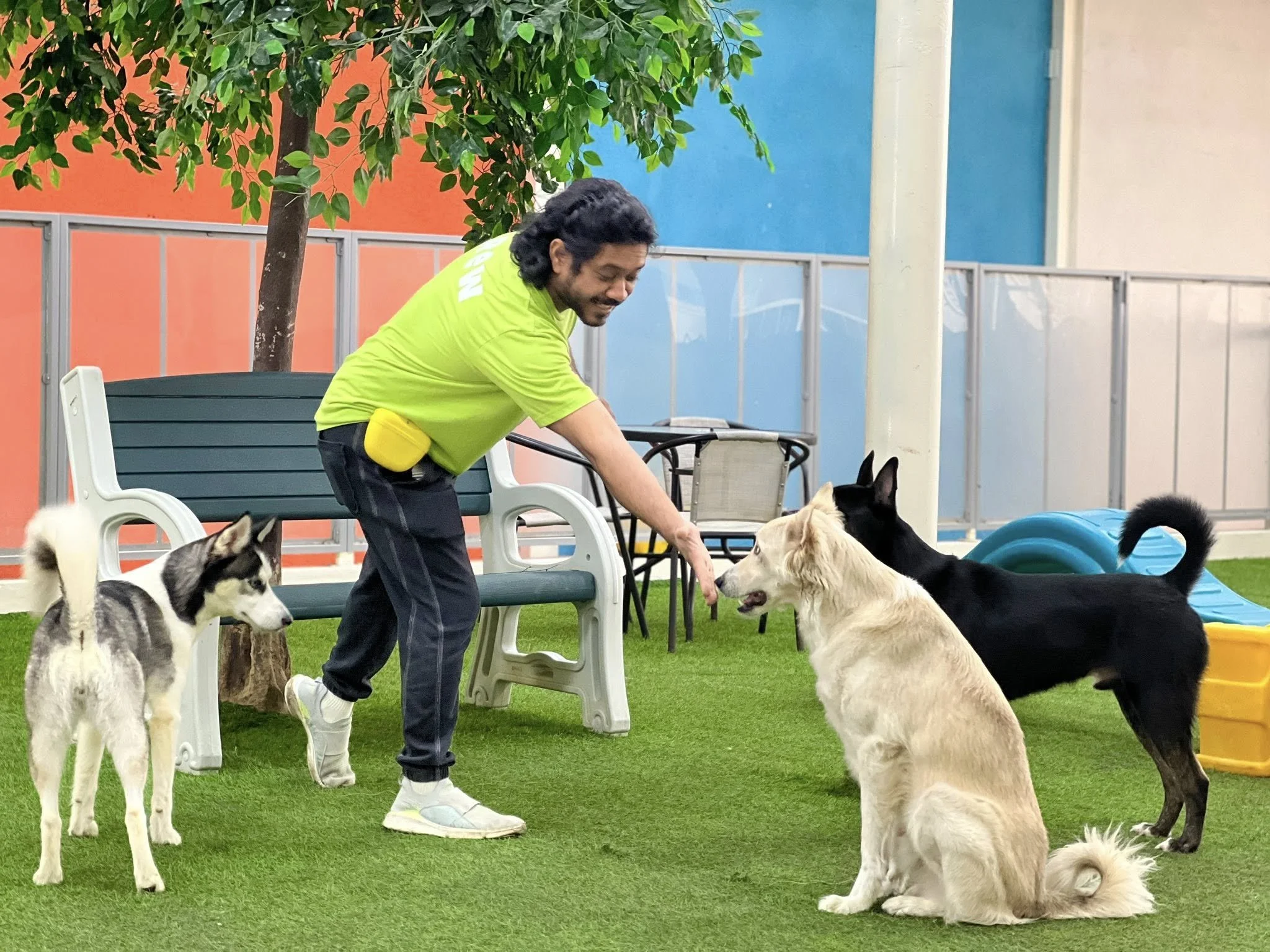
Research in canine stress physiology consistently shows that environmental conditions are a significant factor in elevating cortisol levels in dogs (Cobb et al., 2016; Muns Vila et al., 2024). In plain terms: a dog who already knows a place, already associates it with good experiences, is a fundamentally different dog going into an overnight stay than one who's never been there before.
A facility worth trusting will strongly encourage this. Not just a quick meet-and-greet, but real time, enough visits until the dog has settled, explored, played, and rested in that environment before they're ever left there overnight.
Just to add, "cage free" boarding may sound lovely, until you realise they will inevitably have to spend time 24/7 with an entire group of dogs for however long they stay (and is actually not permitted by Dubai Municipality, as facilities are required to have a run available for every dog on site at all times, even in free-play providers). In our early days at Fetch we too had offered this, and quickly switched to offering Tuck-in and Snuggles as an alternative once we saw how exhausting it turned out to be for the dogs.
What does rest look like during the day?
Dogs need more sleep than most people realise. Adult dogs typically require between 12 and 16 hours of rest per day depending on age, breed, and activity level, and working or high-energy breeds often need more (PetMD, 2026; Rover, 2025). A daycare or boarding environment that runs continuous group activity or non-stop free-play is not giving dogs what they need, regardless of how fun it looks for us humans.
More importantly, how a facility handles rest tells you something about how they handle everything else. Are dogs given a consistent, comfortable space to wind down? Is that space somewhere they've been before, somewhere associated with positive experiences? Or is it somewhere they're placed when they've become too much to manage?
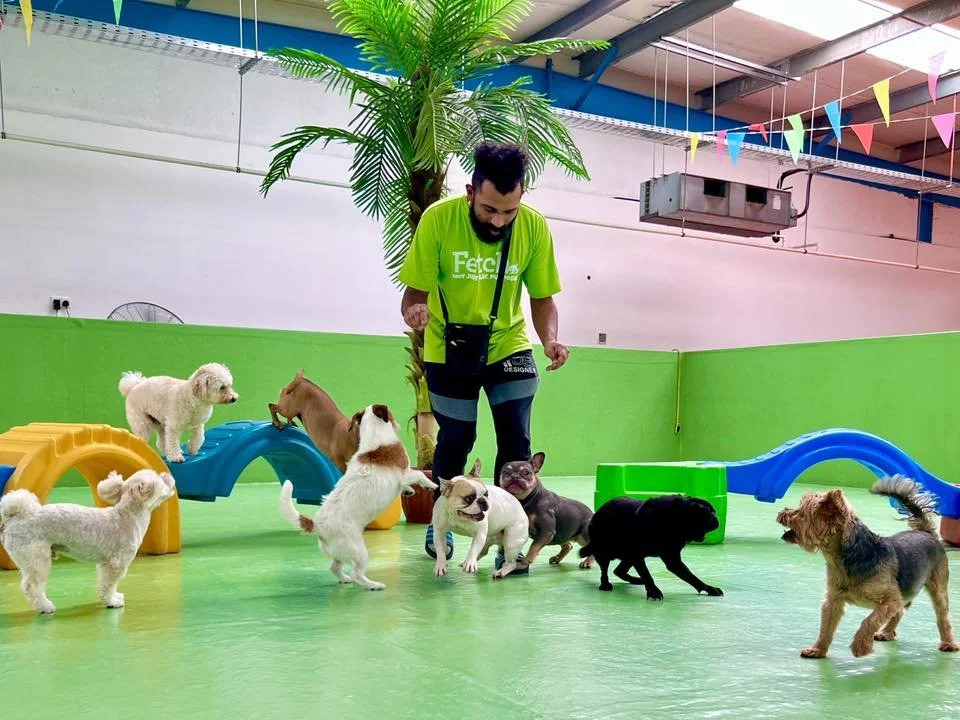
The distinction matters. A dog who regularly rests in a specific space as a normal, pleasant part of their day will move into that space during boarding without distress. A dog who only ever goes there when overstimulated or in trouble will carry that association into every overnight stay.
How do they handle over-arousal?
Group environments get stimulating. Dogs feed off each other's energy, and even the most balanced dog can tip into a state of over-arousal, not because something went wrong, but because that's how dogs work in social settings.
What a facility does in that moment reveals their actual philosophy. Punishment-based responses, raised voices, physical corrections, isolation as consequence, do not address the underlying arousal. They add stress to an already elevated nervous system.
The evidence-based approach is nose work and, particularly relevant here, rest. Calm, positive, unhurried rest. Giving a dog the opportunity to regulate their own nervous system in a space they find safe and familiar. This is not a timeout. It's not a consequence. It's an understanding that behaviour is physiological before it's anything else, and that a dog who's been redirected into rest will return to a group calmer, more settled, and better equipped to engage.
A facility that understands this will be able to explain it clearly. If the answer to "what do you do when a dog gets overexcited?" is vague, that's worth noting.
Are the people there trained in fear-free handling?
Fear Free is a certification programme built on the science of reducing fear, anxiety, and stress in animal care settings. It covers handling techniques, environmental design, reading canine body language, and understanding how veterinary and care experiences shape a dog's long-term emotional health.

It is not common. In the UAE, it remains rare. If a facility holds Fear Free certification, it means their team has been formally trained to recognise stress signals that most handlers miss entirely, and to adjust their approach accordingly.
Ask specifically. Not "are your staff trained", everyone will say yes, but "do your handlers hold any sort of certification, and at what level?"
What's the staff-to-dog ratio?
There's no universal legal standard for this in Dubai, which means facilities self-regulate. A low ratio means more individual attention, faster recognition of stress signals, and more consistent handling. A high ratio means dogs are being supervised rather than cared for. The former is more labour-intensive, in other words, more expensive. The latter is of course where costs can be cut.

Ask what the ratio is during active sessions, or better yet, in that moment of talking to them. You'll know if you receive a rehearsed answer, or one that reflects their true numbers by the time they take to retrieve that information.
Eid is a long weekend. That's several nights for your dog in an unfamiliar environment, or a familiar one, depending on the choices made weeks before the holiday. That trust is built on familiarity, and familiarity takes time to build.
We also wrote about decompression stress, a real concern especially for dogs who aren't daycare-suited or aren't acclimatised to their environment, a phenomenon occurring once they are back home to safety and can finally relax, and one that can be particularly upsetting not only for the dog experiencing it, but for you, their human.
If you're thinking about where your dog will spend Eid, the most useful thing you can do right now is start that conversation early, visit with your dog, and pay attention to how the facility responds to the questions above.
References
Cobb, M.L., Iskandarani, K., Chinchilli, V.M. and Dreschel, N.A. (2016) 'A systematic review and meta-analysis of salivary cortisol measurement in domestic canines', Domestic Animal Endocrinology, 57, pp. 31-42.
Muns Vila, R., Manteca, X. and Salas, M. (2024) 'Behavioral, Physiological, and Pathological Approaches of Cortisol in Dogs', Animals, 14(23), p. 3536. Available at: https://www.mdpi.com/2076-2615/14/23/3536
PetMD (2026) 'Why Do Dogs Sleep So Much?'. Available at: https://www.petmd.com/dog/general-health/how-many-hours-does-dog-sleep-day
American Kennel Club (2024) 'How Much Do Dogs Sleep?'. Available at: https://www.akc.org/expert-advice/health/how-much-do-dogs-sleep/