
Is Your Dog Getting Worse on Walks? Daycare Might Be Why.

You haven't imagined it.
Your dog was manageable on walks six months ago. Maybe not perfect but manageable. Now they lunge, spin, bark, or pull so hard your shoulder aches. You've started dreading going out. You've crossed the road to avoid other dogs. You've wondered, quietly, if something is wrong with your dog.
Before you blame yourself, or write it off as your dog "just being reactive," there's a question worth asking: what does their daycare day actually look like?
Because for many dogs attending large, unstructured group daycare, the walks aren't getting harder despite daycare. They're getting harder because of it.
The problem isn't your dog. It's what they've been practising.
Dogs learn through repetition. Every experience reinforces a pattern and in an overstimulating daycare environment, that pattern is often one guardians don't see until it shows up on a lead.
When a dog spends hours in a large, chaotic group, dogs arriving and leaving, noise levels spiking, play escalating without structure or breaks, their nervous system runs hot. Experts in animal behaviour note that dogs in this state become reactive not because they are inherently aggressive, but because they have been conditioned to respond to other dogs with high-arousal behaviour.¹
Research cited in Applied Animal Behaviour Science found that dogs in group play settings show significantly higher cortisol levels, the hormone associated with stress arousal, compared to more structured interactions.² Sustained elevated cortisol doesn't just disappear when the day ends. It shapes how a dog processes future stimulation, including the dog they see on a quiet street the next morning.
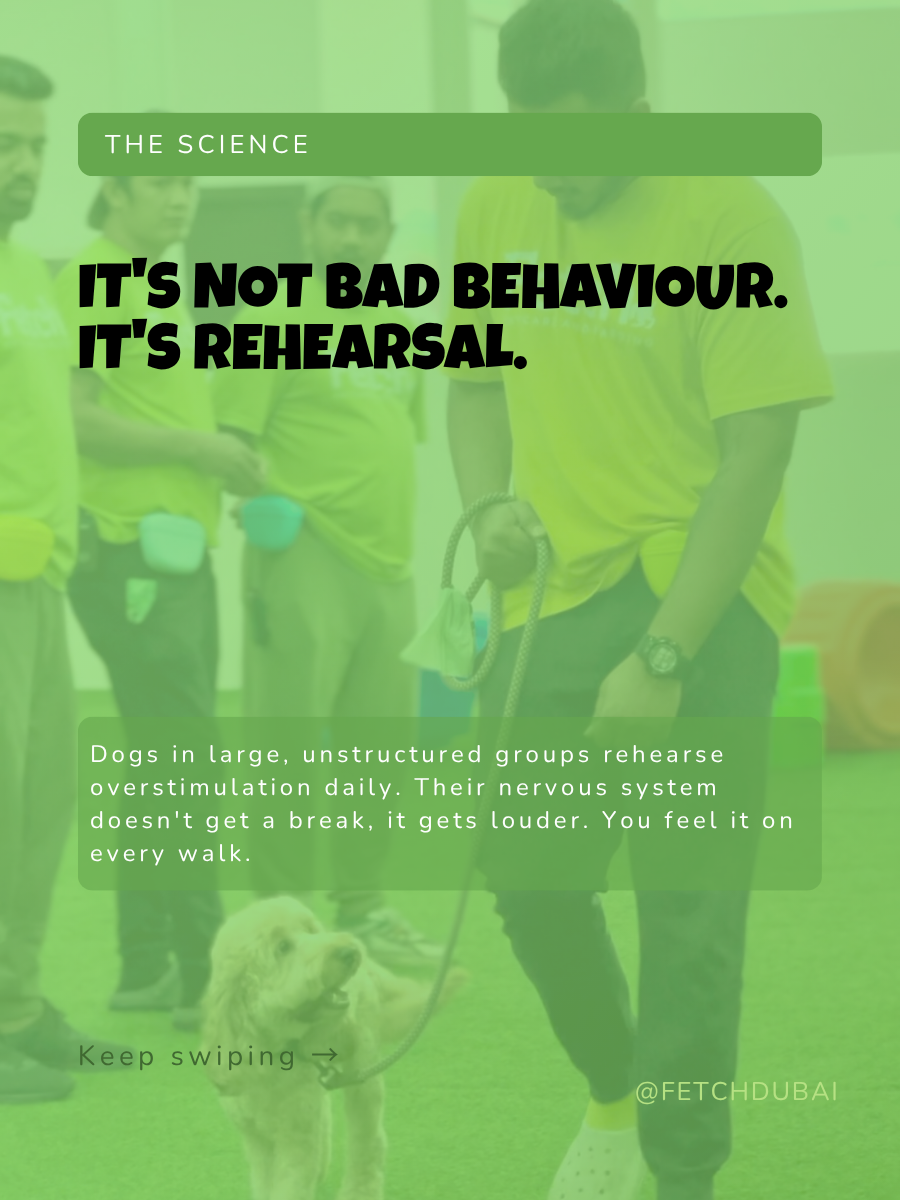
"It's not bad behaviour. It's rehearsal. And daycare might be running the rehearsal every single day."
Patricia McConnell, a respected animal behaviourist, has noted that fearful dogs forced into large group environments can become more reactive over time, not less.³ The assumption that more exposure equals better socialisation doesn't hold up. What matters is the quality of the interaction, not the quantity of dogs in the room.
What overstimulation looks like after daycare
Most guardians attribute the signs to a "hard day" or assume their dog is just tired. But there's a meaningful difference between a dog who's genuinely settled and one whose nervous system has been running at full tilt for eight hours.
Watch for these after a daycare day:
Unable to settle at home, pacing, seeking stimulation, resistant to rest
More reactive or snappy in the evening, with people, other pets, or sounds
Harder to handle on the walk the following morning
Reluctant or hesitant at drop-off, then dismissed as separation anxiety
No measurable progress in behaviour over weeks or months of attendance
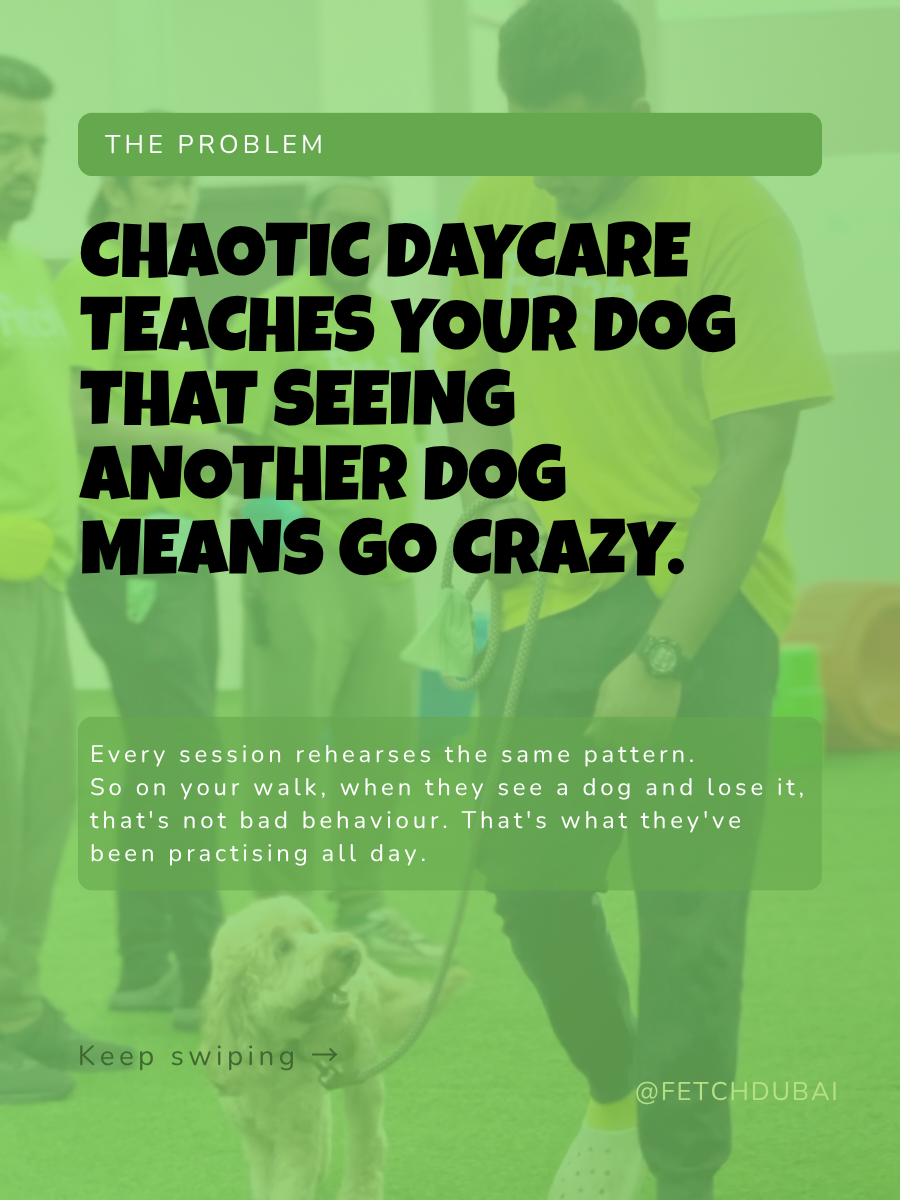
As behaviour professionals have written: "Many dogs become overstimulated from the repetition of visiting daycare on a daily basis, meaning they will end up being bad listeners, display reactivity or aggression, and be unable to settle down and relax after coming back home."¹
Worth knowing: overstimulation and stress arousal are not always loud. Some dogs shut down quietly, becoming withdrawn, disengaged, or flat rather than showing obvious reactivity. Both responses indicate a nervous system that hasn't had the conditions to recover.
The socialisation myth that's costing dogs their wellbeing
The idea that putting a dog in a room with twenty other dogs constitutes socialisation is one of the most persistent misconceptions in the industry and one of the most damaging.
True socialisation is about quality of interaction: compatible temperaments, calm environments, managed introductions, and the ability to disengage when needed. A facility that rotates dogs through large groups, with different animals and handlers every visit, isn't building social confidence. It's rehearsing chaos.
Dogs without sufficient positive early experiences can actually become more reactive when pushed into large group environments, not less.³ The exposure without structure doesn't teach dogs to be comfortable, it teaches them to cope. And coping looks very different from thriving.
What to actually look for in a dog daycare in Dubai
Before you rebook next month, it's worth asking some questions your facility should be able to answer about your dog specifically, not dogs in general.
How many dogs are in your dog's playgroup, and is that group consistent?
Does your dog have the same handler each visit, or does it change?
What specific behaviours or progress have they noticed since your dog started?
What happens when your dog shows signs of stress or disengagement?
What does a written or video update look like, and does one exist?
If the answers are vague or if "they were great" is the most detail you receive, that's information too.
At Fetch Dubai, every dog attends on a monthly programme with the same small playgroup and the same handler. We track behaviour across every session, identify stress signals before they become patterns, and send a written report and video at the end of every visit. Dog daycare in Dubai should make your dog easier to live with — not harder. If it isn't, it's worth understanding why.
It's not your dog. And it's not too late.
Reactivity that has been reinforced through an overstimulating environment can be unwound — but it requires a different kind of daily experience. Smaller groups. Predictable social partners. Handlers who read stress signals early and respond thoughtfully. Structured play with a start, a middle, and an end.

The dogs who make the most progress at Fetch are often the ones whose guardians came to us having assumed the problem was their dog. It usually isn't. It's what the dog has been taught to expect — and with the right environment, that changes.
If you're in Dubai and you're starting to question whether your dog's daycare is helping or adding to the problem, we're happy to talk. Our assessment process is designed to find out whether Fetch is the right fit for your dog and to be honest if it isn't.
References
2 Paws Up Inc. (2022). The Overstimulated Daycare Dog. https://2pawsupinc.com/2022/09/05/the-overstimulated-daycare-dog/
Wagbar (2024). Overstimulated Dog at the Park: Recognizing and Managing Arousal Levels, citing Applied Animal Behaviour Science. https://www.wagbar.com/overstimulated-dog-at-the-park-recognizing-and-managing-arousal-levels
The Modern Dog Trainer (2017). 5 Reasons Not To Do Doggy Day Care. https://www.themoderndogtrainer.net/5-reasons-dog-not-good-fit-doggy-day-care/
Beaurpere, N. & McMahon, C. (2024). "Overstimulated": How Did We Get Here and What Can We Do Now. Dingo's Dogsitting. https://dingosdogsitting.com
Aska's Animals (2023). Cortisol and Your Dog's Brain. https://askasanimals.org/cortisol-and-your-dogs-brain/
PMC / NCBI (2024). Behavioral, Physiological, and Pathological Approaches of Cortisol in Dogs. PMC11640126. https://pmc.ncbi.nlm.nih.gov/articles/PMC11640126/