
Force Free, Positive Reinforcement, Balanced Training, What Is the Difference?
If you have spent any time looking into dog training in Dubai, you have probably encountered a wall of terminology. Positive reinforcement. Force free. Reward-based. Balanced. Science-based. It all sounds good. Some of it is. Some of it is not.
The term balanced training sounds reasonable on the surface. A balance of positive and negative, carrot and stick. In practice, it is often used to describe approaches that include the use of aversive tools and techniques to suppress behaviour. Not correction in the sense of redirection. Suppression in the sense of making the unwanted behaviour painful or frightening enough that the dog stops performing it.
The distinction between suppression and resolution matters enormously, and it is not always visible from the outside.
What the quadrants actually mean
Operant conditioning, the framework underlying most modern dog training, describes four ways to change behaviour. Positive reinforcement adds something the dog wants to increase a behaviour. Negative reinforcement removes something aversive to increase a behaviour. Positive punishment adds something aversive to decrease a behaviour. Negative punishment removes something the dog wants to decrease a behaviour.
All four quadrants exist in animal learning science. The debate in the training world is not whether they work in the narrow sense. It is about welfare, about the relationship between handler and dog, and about what the research actually shows when you look at outcomes beyond immediate compliance.
A 2020 study in PLOS ONE examined behavioural and physiological measures in dogs trained with aversive methods versus reward-based methods (Vieira de Castro et al., 2020). Dogs trained with aversive methods showed significantly more stress-related behaviours during training, had higher cortisol levels after training, and spent less time in a relaxed body posture. These findings held even for dogs whose handlers considered themselves to be using aversives minimally or appropriately.
What force free actually means
Force free is a commitment to training without the use of pain, fear, or intimidation. It does not mean permissive. It does not mean a dog gets to do whatever they want. It means that when a behaviour needs to change, the approach is to give the dog better information and better options, not to make the current behaviour painful enough that they stop.
The Pet Professional Guild defines force-free handling as a commitment that covers not just formal training sessions but every interaction a handler has with a dog throughout the day. How a dog is moved from one space to another. How a conflict between dogs is managed. How a dog who is struggling is handled. Force-free is a framework for all of it, not just the formal training moments. At Fetch, we align with these principles and the Do No Harm standard in how we operate every day.
Why it matters for daycare specifically
Most dog daycare is not thought of as a training environment. But every interaction a dog has throughout their day is either building or eroding their confidence, their trust in humans, and their sense of safety in the world. A handler who uses force or intimidation to manage a dog who is struggling in a group setting is not just training a behaviour. They are shaping that dog's emotional associations with the facility, with strangers, and potentially with other dogs.

This is why the methodology of the facility matters, not just the playspace or the staffing ratio. A Fear Free certified facility with force-free handling produces a different experience for a dog, every day, whether you can see it in the Instagram photos or not.
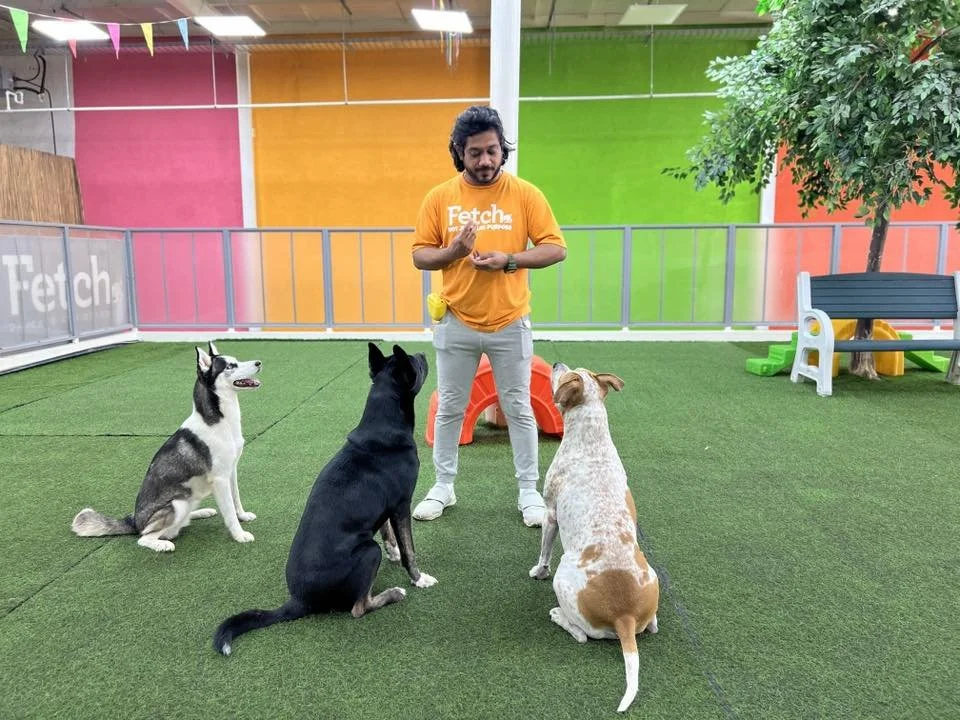
At Fetch, every Practice session and every handler interaction is built on positive reinforcement and force-free principles. We are Fear Free certified and Do No Harm aligned. These are not badges. They are a framework that gets applied to every decision we make.
Want to see what force-free care looks like in practice?
Learn about our approach or explore our Practice programme. If you are ready to get started, join the waitlist and we will take it from there.
References
Vieira de Castro, A.C., Fuchs, D., Morello, G.M., Pastur, S., de Sousa, L. and Olsson, I.A.S. (2020). Does training method matter? Evidence for the negative impact of aversive-based methods on companion dog welfare. PLOS ONE, 15(12), e0225023. https://doi.org/10.1371/journal.pone.0225023