
What Actually Happens During a Day at Dog Daycare?
When people ask what dogs do at daycare, the answer they usually get is they play with other dogs. That is not a description of a day. It is a way of avoiding the question.
If a facility cannot tell you what structure the day follows, that absence of structure is itself the answer.
Why structure matters
Dogs are not built to sustain high arousal for eight consecutive hours. Beerda et al. (2000) documented that chronic environmental stress, including sustained noise, unpredictability, and inability to rest, produces measurable hormonal and behavioural stress responses in dogs. A daycare with no structured rest periods is not a welfare-positive environment, regardless of how much the dogs appear to enjoy themselves in the moment.
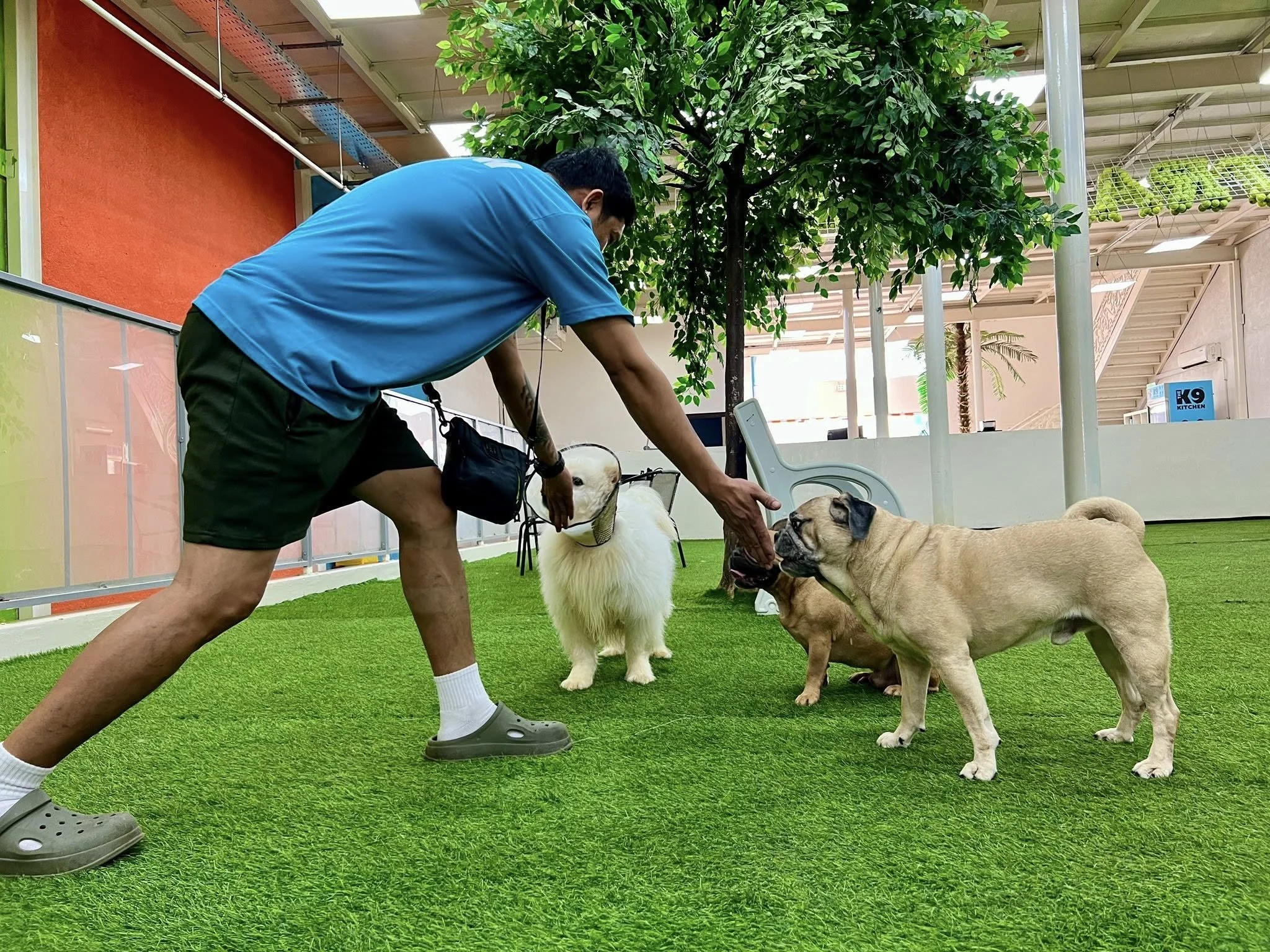
Enjoyment and regulation are not the same thing. A dog can be intensely engaged, running, chasing, vocalising, while also being over-threshold. Sustained overarousal is not the same as a good day.
What a well-structured day includes
Morning arrival and settling
The beginning of the day matters. Dogs who arrive into a chaotic environment of already-excited dogs have to navigate that energy immediately, before they have had a chance to settle. A well-run facility manages arrivals to give dogs time to orient and decompress before engaging with the group.
Active periods with supervision
Supervised play should be exactly that, supervised. Staff should be watching for escalation, managing interactions between specific dogs, and use redirection as a way of intervening before situations tip. Taylor and Mills (2007) found that the quality of human oversight in group canine environments was significantly correlated with welfare outcomes.
The number of staff relative to dogs matters. A 1:15 ratio does not allow meaningful supervision but because it is the bare minimum, is the accepted industry standard. You will find that most facilities in Dubai, at peak periods, host much more that 15 in a group.
Structured rest
Rest is not what happens when dogs are exhausted. Structured rest is a deliberate, managed part of the day where dogs are given time away from the group in a calm environment. This might involve individual spaces, enrichment like lick mats or frozen food items, and reduced stimulation. At Fetch, rest periods are built into the structure of every session, not offered as an afterthought when dogs are flagging or when on one is available to supervise.
Enrichment
Mental engagement is not the same as physical activity. Lund, Agger and Vestergaard (1996) found that behaviour problems in dogs were significantly correlated with insufficient mental stimulation. Enrichment, scent work, food-based activities, problem-solving, addresses a different need than running does. A day that involves only physical play is missing a significant component of what a dog actually needs.
What should not happen
Continuous group play with no breaks. Loud, echoing spaces with no acoustically calm areas. Staff who are present but not actively monitoring. Groups that mix dogs of incompatible sizes, play styles, or arousal levels without separation. These are not just quality concerns, they are welfare concerns.
A dog who comes home and sleeps for 14 hours is not a dog who had a great day. Exhaustion is not the same as satisfaction, and the two get conflated constantly in how daycare is marketed.
What to ask before you book
Ask how the day is structured. Ask what the rest periods look like. Ask the staff-to-dog ratio. Ask what enrichment is offered. Ask what happens if your dog is struggling during the day.
If the answers are vague, that tells you something about how much thought has gone into the day beyond dogs run around together.
What a day at Fetch looks like
Fetch runs structured sessions within familiar, positively associated spaces. Enrichment includes lick mats and frozen food items during downtime. Dogs are monitored throughout the day, and staff use time-in approaches, engaging dogs with enrichment rather than isolation, when a dog needs to step back from the group. Rest is built into every day, not as a consequence of tiredness but as deliberate design.
We also keep group sizes manageable. Not because it is a selling point, but because meaningful supervision requires it. If this is the type of care you have been looking for, start your registration process by filling in our waitlist, and we will get into contact with you soon.
References
Beerda, B., Schilder, M.B.H., van Hooff, J.A.R.A.M., de Vries, H.W. & Mol, J.A. (2000). Behavioural and hormonal indicators of enduring environmental stress in dogs. Animal Welfare, 9, 49–62. https://doi.org/10.1017/S0962728600022247
Lund, J.D., Agger, J.F. & Vestergaard, K.S. (1996). Reported behaviour problems in pet dogs in Denmark: age distribution and influence of breed and gender. Preventive Veterinary Medicine, 28(1), 33–48. https://www.sciencedirect.com/science/article/abs/pii/016758779601015X
Taylor, K.D. & Mills, D.S. (2007). The effect of the kennel environment on canine welfare: a critical review of experimental studies. Animal Welfare, 16(4), 435–447. https://doi.org/10.1017/S0962728600027378