
Why Temperament Testing Matters Before Dog Daycare
Most daycare facilities will take any dog that shows up. The ones worth attending will not. Temperament testing is not a gatekeeping exercise, it is how a responsible facility protects every dog in its care, including yours.
If a daycare has never turned a dog away, that tells you something. It tells you they are prioritising occupancy over safety.
What temperament testing is actually assessing
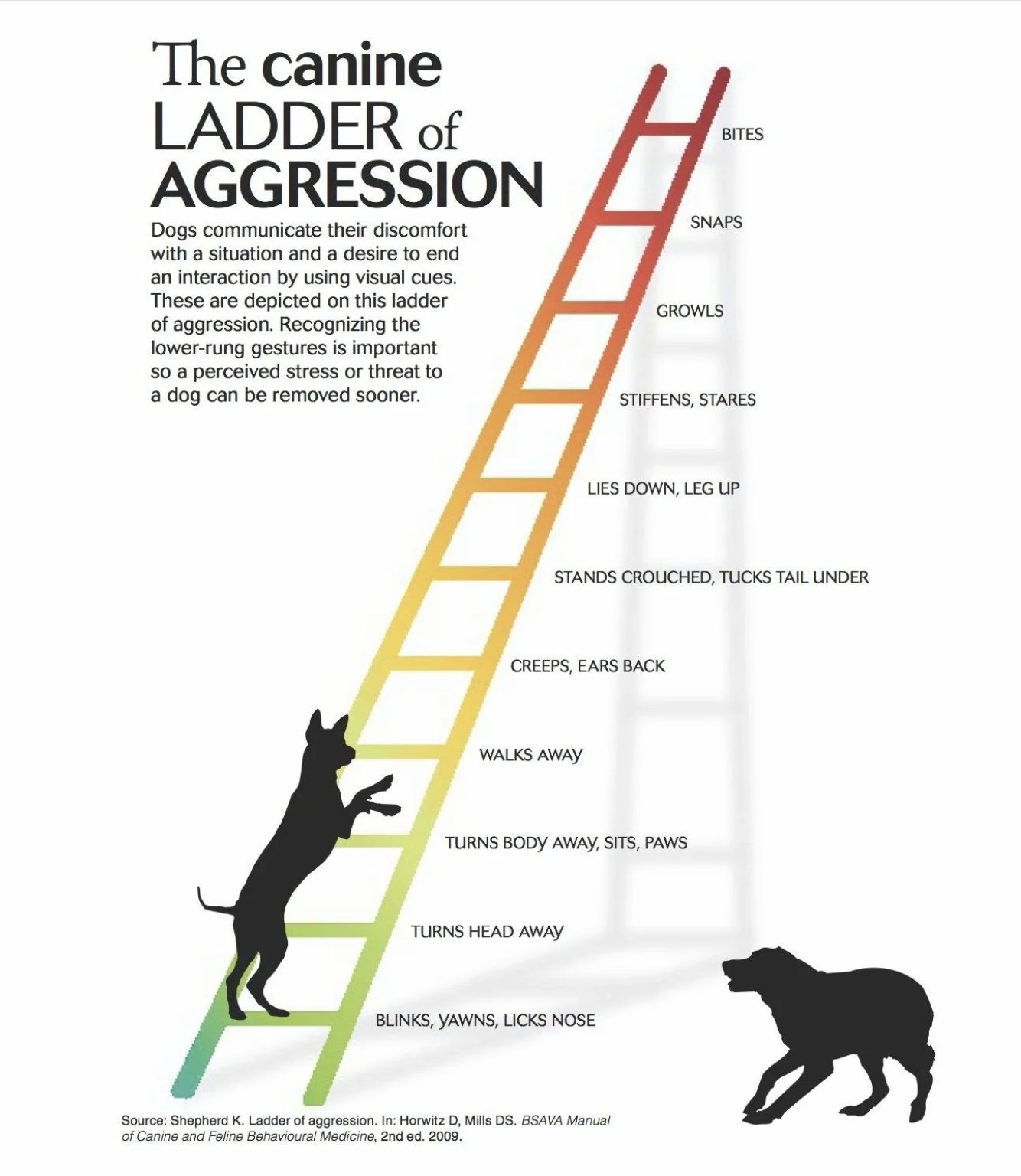
A meaningful assessment does not just check whether a dog is aggressive. Aggression is the visible end of a spectrum that begins with much subtler stress signals, tension around the mouth, stiffness in the body, avoidance, whale eye, displacement behaviours. The Shepherd ladder of aggression describes how dogs escalate from low-level discomfort to overt aggression when their earlier signals are ignored. A good assessment reads the whole ladder.
What a structured assessment is looking for includes how a dog responds to unfamiliar people and environments, whether they can settle after a period of arousal, how they signal discomfort, and whether they show resource guarding or reactivity patterns that would make group settings unsafe. It is also assessing the fit between that specific dog and that specific facility, not just whether the dog is generally fine with dogs.
Why group settings require more than basic friendliness
A dog can be perfectly pleasant in one-on-one interactions and struggle significantly in group environments. Dogs who are fine meeting others on walks may be overwhelmed by sustained, inescapable proximity to multiple unfamiliar dogs. Dogs who are social but easily overaroused can become triggers for other dogs. The question is not just does your dog like dogs, but how does your dog function in this kind of density, for this duration, on a repeated basis.
The difference between screening and turning dogs away
A selective intake model does not mean a facility rejects difficult dogs. It means the facility is honest about what it can and cannot safely support. Höglin et al. (2021) found that chronic environmental mismatch, placing dogs in conditions that consistently exceed their stress tolerance, produces measurable long-term physiological stress responses. A dog who is not a good fit for group daycare is better served by a different arrangement than by being placed in an environment that stresses them daily.
When a facility turns a dog away, they are not saying the dog is bad. They are saying this particular environment is not the right match. That is a care decision, not a judgment.
What the assessment process should look like
A proper assessment is not a five-minute meet-and-greet at the front desk. It involves the dog spending time in the actual environment, the sounds, the smells, the other dogs at a safe distance, and being observed by staff who know what they are looking for. It is gradual. It is not rushed to get the dog booked in faster.
At Fetch, no dog moves to full sessions before completing an acclimatisation process. This is partly about assessment and partly about giving the dog the chance to build genuine positive associations with the space. Both matter.
Questions worth asking any daycare
Before you enrol your dog, ask the facility what their assessment process involves. Ask what happens if a dog shows stress signals during the day. Ask whether they have ever declined to take a dog, and why. Ask who on staff has behaviour training and what that training consists of.
Miklósi (2015) notes that dogs are highly sensitive to social context and that their behaviour in one setting does not reliably predict behaviour in another. A facility that understands this will have systems to assess and monitor accordingly. One that does not will tell you your dog will be fine because they have always been friendly before.
The bottom line
Temperament testing is not a hoop to jump through. It is the mechanism by which a daycare facility demonstrates that it takes the welfare of the dogs in its care seriously. A facility without a meaningful assessment process is a facility without a meaningful welfare position.
If you are looking for daycare in Dubai and want to understand how Fetch approaches intake and assessment, get in touch. We will tell you exactly what the process looks like and whether we think it is the right fit for your dog.
References
Höglin, A., Van Poucke, E., Katajamaa, R., Jensen, P., Theodorsson, E. & Roth, L.S.V. (2021). Long-term stress in dogs is related to the human–dog relationship and personality traits. Scientific Reports, 11, 8612. https://doi.org/10.1038/s41598-021-88201-y
Miklósi, Á. (2015). Dog Behaviour, Evolution, and Cognition. 2nd ed. Oxford University Press. https://www.amazon.com/Behaviour-Evolution-Cognition-Adam-Miklosi/dp/019964666X
Taylor, K.D. & Mills, D.S. (2007). The effect of the kennel environment on canine welfare: a critical review of experimental studies. Animal Welfare, 16(4), 435–447. https://doi.org/10.1017/S0962728600027378