
How to Know If Your Dog Is Ready for Daycare
Readiness for dog daycare in Dubai is not about age or breed. It is about whether your dog has the emotional resources to cope with a group environment, and whether the environment is ready for your dog.
This is a question most facilities do not ask. They have availability, so they take bookings. But placing a dog in daycare before they are ready does not accelerate their development. It creates stress, and in some cases sets back the progress a dog has already made.

What readiness actually means
A dog who is ready for daycare can do a few things reliably. They can settle in a new environment without prolonged distress. They can disengage from stimulation, they do not spiral into overarousal and stay there.
They show curiosity rather than fear when encountering unfamiliar dogs and people. They recover reasonably quickly from unexpected events.
None of this requires a dog to be perfectly trained or highly social. It requires them to have enough emotional regulation to function in a busy, unpredictable environment without tipping into chronic stress.
Dietz, Arnold, Goerlich-Jansson and Vinke (2018) found that early life experience and socialisation history have lasting consequences for how dogs regulate themselves in novel or demanding environments. This fact we take incredibly serious at Fetch, as its ultimately you who has to live with them for their entire life. A dog with significant gaps in socialisation, or one who experienced early stress, may genuinely need a more graduated approach before group daycare is appropriate, and the help of a fear-free certified behaviourist.
Signs your dog may not be ready yet
Persistent hiding or shutdown in new spaces. Inability to disengage from arousal, the dog stays frantic or vigilant for extended periods. Reactivity toward unfamiliar dogs that does not settle with exposure. A good example is reactivity during butt sniffing, a normal behaviour for dogs. Significant distress at separation that has not been worked on. These are not disqualifying traits forever, but they signal that group daycare is not the right next step.
Tiira, Sulkama and Lohi (2016) found anxiety-related behaviours in dogs often co-occur, a dog who is noise-sensitive may also struggle with social unpredictability, and a dog who is fearful of strangers may find a group environment overwhelming in ways that are not immediately obvious. One anxious trait is worth taking seriously as a signal that the whole picture needs assessing.
Signs your dog is likely ready
They investigate new spaces with interest rather than alarm. They are comfortable being handled by people they have just met. They can play with other dogs and disengage when play gets too intense. They settle when given the opportunity. They recover quickly when startled.
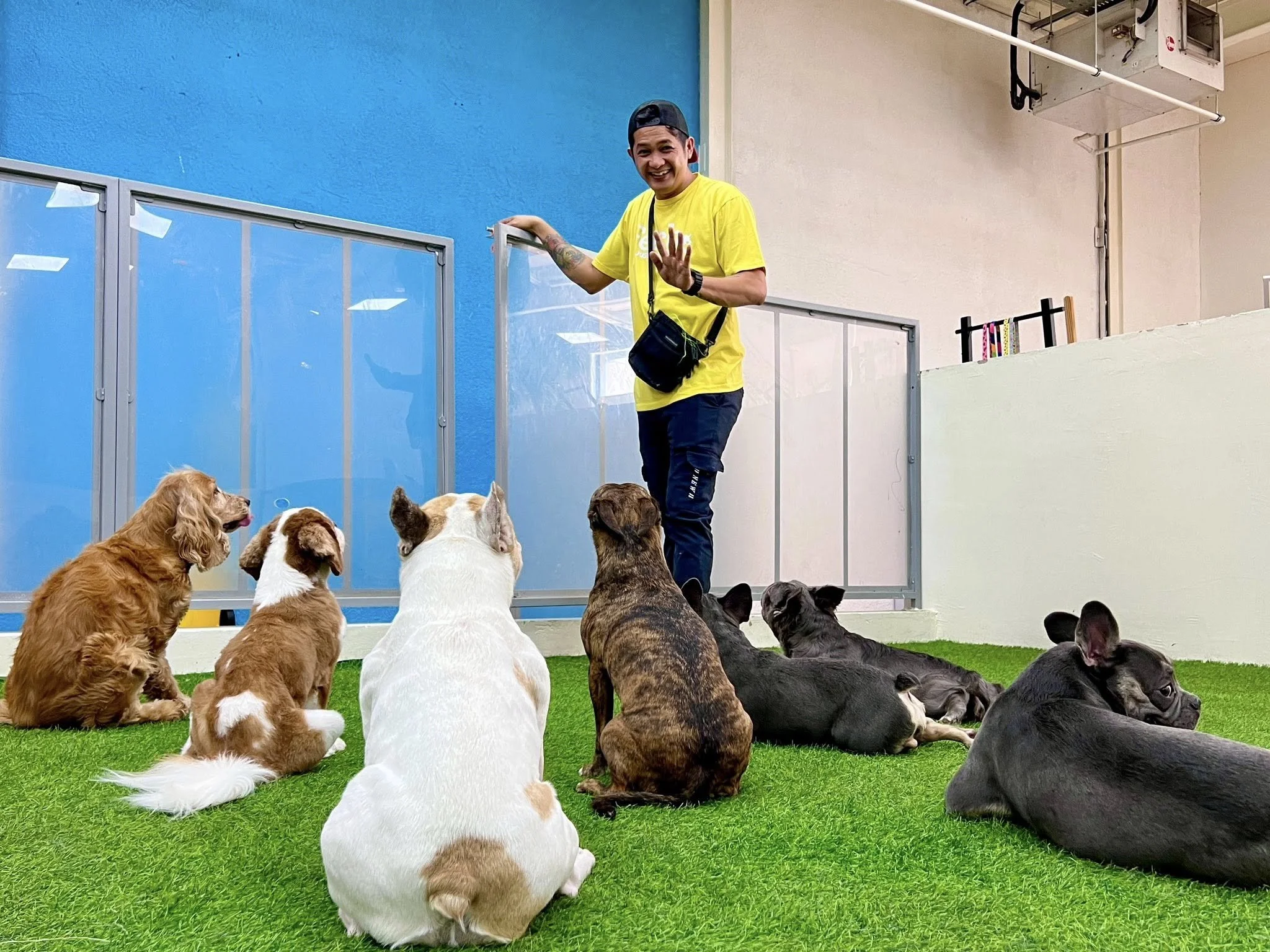
These are not guarantees, a dog can present well in a one-off meeting and still struggle in the sustained proximity of group daycare. But they are meaningful indicators. This is the main motivation behind our 4 day acclimatization month, it allows us to truly get to know each dog walking through our doors.
What the acclimatisation process is for
Even for dogs who are ready, the transition into daycare should be gradual. Beerda et al. (2000) documented that novel environments with unpredictable social demands produce measurable stress responses in dogs, even when the individual dog is generally resilient. The acclimatisation process is not a formality. It is how the facility becomes a familiar, positively associated space rather than a recurring source of novelty-induced stress.
At Fetch, we require acclimatisation before a dog moves to full sessions. This is not about gatekeeping. It is about giving the dog the best chance of actually benefiting from being there.
The facility's readiness matters too
Readiness is a two-way question. A dog may be ready for a well-run daycare and not ready for a poorly run one. Taylor and Mills (2007) found that the quality of the environment, structure, predictability, rest opportunities, human oversight, significantly mediates how dogs experience group settings. Placing a ready dog in an unstructured facility is not the same as placing them in a structured one.
Before you ask whether your dog is ready, ask whether the facility is ready for your dog. Ask what the day looks like. Ask how they handle dogs who are struggling. Ask whether they have turned dogs away, and why.
If you are unsure whether your dog is at the right point for daycare, reach out. We will tell you what we are looking for and give you an honest assessment.
References
Beerda, B., Schilder, M.B.H., van Hooff, J.A.R.A.M., de Vries, H.W. & Mol, J.A. (2000). Behavioural and hormonal indicators of enduring environmental stress in dogs. Animal Welfare, 9, 49–62. https://doi.org/10.1017/S0962728600022247
Dietz, L., Arnold, A.K., Goerlich-Jansson, V.C. & Vinke, C.M. (2018). The importance of early life experiences for the development of behavioural disorders in domestic dogs. Behaviour, 155(2–3), 83–114. https://doi.org/10.1163/1568539X-00003486
Taylor, K.D. & Mills, D.S. (2007). The effect of the kennel environment on canine welfare: a critical review of experimental studies. Animal Welfare, 16(4), 435–447. https://doi.org/10.1017/S0962728600027378
Tiira, K., Sulkama, S. & Lohi, H. (2016). Prevalence, comorbidity, and behavioral variation in canine anxiety. Journal of Veterinary Behavior, 16, 36–44. https://doi.org/10.1016/j.jveb.2016.06.008