
We Don't Run Groups. We Run Relationships.
Most dog care facilities will tell you their team loves dogs. That's the baseline. It's not a differentiator.
What they won't tell you is how often the people handling your dog change, how many dogs each handler is responsible for at once, or whether the person your dog meets on Tuesday is the same one they'll see on Thursday. These things matter more than any facility feature or square footage figure.
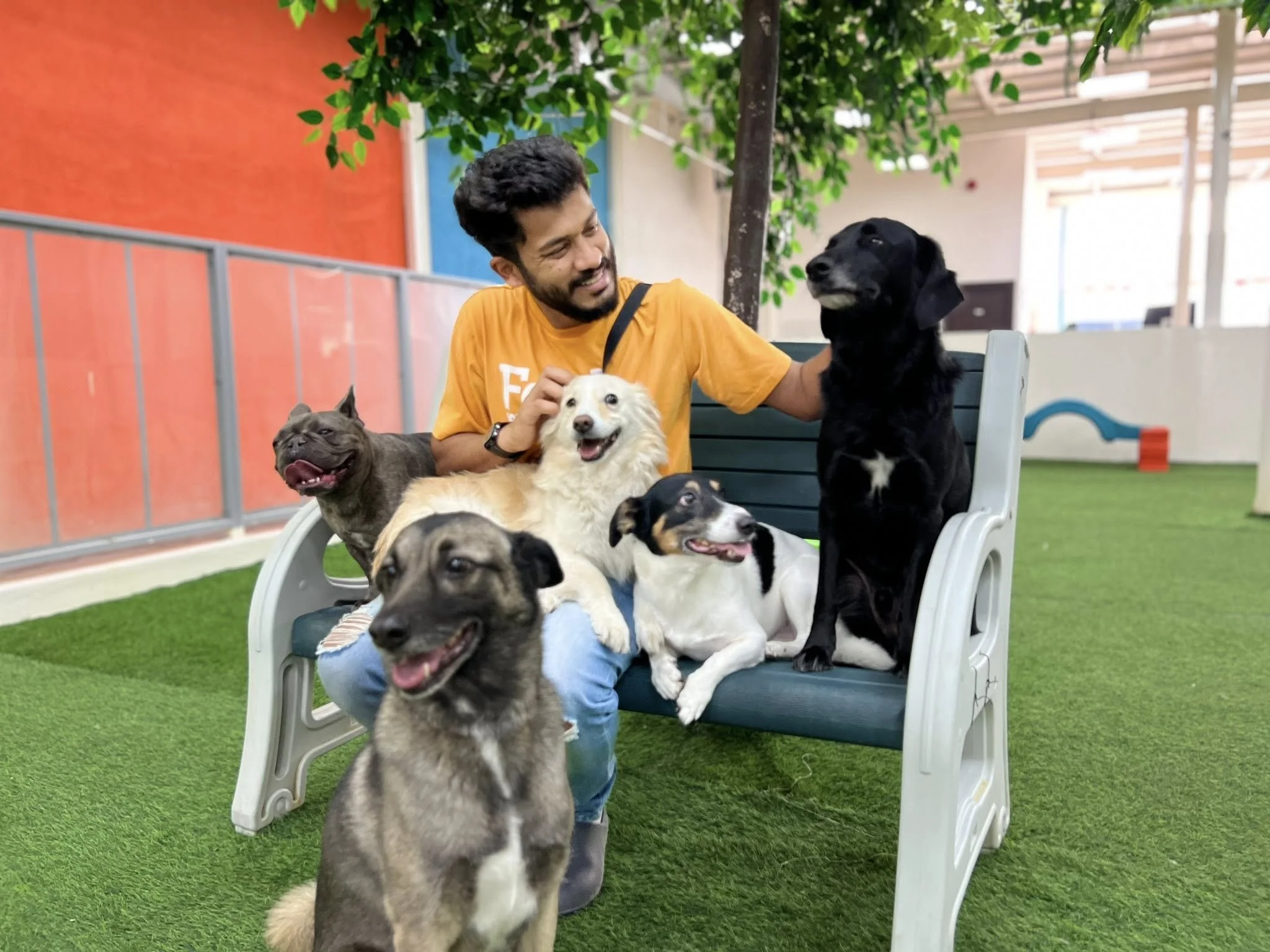
Why your dog notices who handles them
Dogs are not indifferent to who handles them. A peer-reviewed study measuring cardiac activity in dogs across repeated handling sessions found that increasing familiarity with both the setting and the handler produced significant reductions in heart rate and improvements in heart rate variability, both established physiological markers of reduced stress.¹ A dog meeting a new handler isn't just meeting a stranger. They're recalibrating their entire sense of safety in that environment from scratch.
This has a direct practical consequence. A dog who is physiologically stressed, even at a subclinical level, is a dog who is less able to regulate their behaviour, less able to read and respond appropriately to other dogs, and more likely to carry that stress home. The tired dog who collapses on the couch after daycare isn't always a dog who had a great day. Sometimes they're a dog who spent eight hours managing an environment that never quite felt safe.
The accumulation problem
Fear in dogs doesn't always arrive as a single dramatic event. Research into canine fear learning shows that stress accumulates across exposures, and that low-grade, repeated uncertainty can produce the same avoidance and reactivity patterns as a single aversive incident.² A dog who is mildly unsettled by a new handler, then mildly unsettled by a new group configuration, then mildly unsettled by an unpredictable interaction, isn't experiencing three minor inconveniences. They're building an association between that environment and a state of not knowing what comes next.
Once avoidance responses develop, they're self-reinforcing. The dog avoids the stimulus, never gets the chance to learn it isn't threatening, and the association holds. This is part of why behavioural issues that seem to appear suddenly often have a longer history than anyone noticed.
What the training method signals
The relationship between a dog and a handler isn't just about familiarity. It's built through every interaction, including the micro-interactions most people wouldn't clock as training. How a handler redirects a dog who is jumping. How they respond when a dog hesitates at a doorway. Whether they wait for voluntary engagement or use pressure to move a dog from point A to point B.
Dogs trained and handled using aversive or pressure-based methods show measurably more stress-related behaviours both during and after those interactions compared to dogs handled using reward-based approaches, and this difference shows up in their behaviour at home, not just in the facility.³ ⁴ Force-free isn't a marketing term. It's a description of what the relationship between a handler and a dog is built on.
What this looks like at Fetch
We operate a selective intake model. That isn't about exclusivity, it's about capacity. Every dog who joins Fetch is acclimatised before they board, and acclimatisation before boarding. The same handlers. The same rhythms. The same familiar faces.
We use time-in rather than time-out as a default response to overstimulation. Lick mats, frozen Kongs, quiet spaces. Not because it looks good, but because a dog who has somewhere to decompress is a dog who can come back into the group regulated rather than depleted.
Rest is built into every day. Not as an afterthought, not when a dog looks obviously exhausted, but as a scheduled part of the programme, because the research on canine cognitive fatigue is clear that mental load without recovery produces the same deterioration as physical overexertion.⁵
None of this is difficult to say. The harder part is building a facility where it's actually true every day, with every dog, regardless of how full the schedule is.
The question worth asking
Before you commit your dog to any facility, ask how many handlers they'll interact with in a typical week. Ask what happens when a dog is overwhelmed. Ask whether the team is trained in animal behaviour or just experienced with dogs, because those are not the same thing.
The answer to those questions tells you more than any five-star review.
REFERENCES (use numbered list at bottom):
Bremhorst, A., Sutter, N.A., Würbel, H., Riemer, S. (2022). Differences in facial expressions during positive anticipation and frustration in dogs. Frontiers in Veterinary Science, 8. https://doi.org/10.3389/fvets.2022.897287
Blackwell, E.J., Twells, C., Seawright, A., Casey, R.A. (2008). The relationship between training methods and the occurrence of behaviour problems, as reported by owners, in a population of domestic dogs. Journal of Veterinary Behavior, 3(5), 207-217.
Ziv, G. (2017). The effects of using aversive training methods in dogs: A review. Journal of Veterinary Behavior, 19, 50-60.
Herron, M.E., Shofer, F.S., Reisner, I.R. (2009). Survey of the use and outcome of confrontational and non-confrontational training methods in client-owned dogs showing undesired behaviors. Applied Animal Behaviour Science, 117(1-2), 47-54.
Kis, A., Gácsi, M., Topál, J., Miklósi, Á. (2012). The effect of the owner's face and direction of movement on dogs' responses in an object choice task. Animal Cognition, 15(4), 593-601.