
Resource Guarding and Dog Daycare: What It Really Means
Many daycares will tell you resource guarding is not a problem at their facility because they do not use food or toys in the group. It sounds reassuring. It is not a welfare position. It is a way of avoiding a harder conversation about whether they can actually manage a dog who guards.
What resource guarding actually is
Resource guarding describes the behaviour patterns a dog uses to control access to something they perceive as valuable. Jacobs, Coe, Widowski, Pearl and Niel (2018c) note that the term covers a spectrum of behaviour, from subtle avoidance and body blocking
through to growling, snapping, and biting, and that the more subtle end of that spectrum is frequently missed or misidentified by owners and caregivers alike.
Critically, what a dog guards is not limited to food or toys. Dogs guard space. They guard resting spots. They guard proximity to people they have formed attachments to. Jacobs, Coe, Pearl, Widowski and Niel (2017) found that owners consistently underidentified the non-aggressive forms of resource guarding, avoidance and rapid ingestion, while being more likely to recognise overt aggression. The implication is that guarding behaviour is far more prevalent in the dog population than reported, because the earlier signals go unnoticed until they escalate.
Why removing resources does not solve the problem
A daycare that removes food and toys from the group is not managing resource guarding, it is removing two categories of trigger while leaving others entirely intact. A dog who guards a favourite resting spot will still guard it in an environment with no food. A dog who guards proximity to a staff member they have bonded with will still guard that person. A dog who guards physical space when aroused will still do so when the environment is at high stimulation, if not with more determination.
Jacobs et al. (2018b) found that resource guarding behaviour patterns in the presence of other dogs were relatively fixed, meaning they were not reliably situation-dependent in the way that people-directed guarding could be. A dog who guards around other dogs is likely to do so across contexts, not only around the specific resource that triggered the behaviour at home.
Telling a guardian that their dog's resource guarding is not a concern because the facility is resource-free is not an honest assessment. It is a shortcut that accepts the dog without accepting the responsibility of actually managing them.
What resource guarding in daycare actually looks like
In a group environment, resource guarding can look like a dog who stiffens when another dog approaches their resting spot. A dog who escalates when a favourite staff member pays attention to another dog. A dog who body-blocks a doorway or a section of space. A dog who is fine until the group becomes compressed, during rest periods, near entry points, or in smaller spaces, and then tips suddenly.
None of these require food or toys to trigger. All of them require staff who are actively monitoring, who understand what the early signals look like, who actually knows each and every dog they’re responsible for, and who can intervene before escalation.
Jacobs et al. (2018a) found that dogs with higher levels of impulsivity and fear were significantly more likely to display resource guarding aggression, both traits that are common in dogs attending daycare and that require careful environmental management, not the assumption that removing objects resolves the underlying profile. This is a big motivation to look for service providers in the pet care industry who heavily focuses on what causes fear, and include skills and manners practices to improve impulse control.
What a facility that takes this seriously actually does
Managing resource guarding in a group environment requires spatial awareness, knowing which dogs cannot share a resting area, which dogs become tense near entry points when others arrive, which dogs have formed attachments to specific staff that need to be monitored. It requires staff who can read the earlier signals, the body stiffening, the hard stare, the shift in posture, before any vocalisation or contact occurs.
It also requires honesty at intake. A dog who guards significantly at home is not automatically unsuitable for daycare, but they require a facility that has thought through their specific profile and can genuinely accommodate it, not one that has simply decided the problem does not exist in their environment.
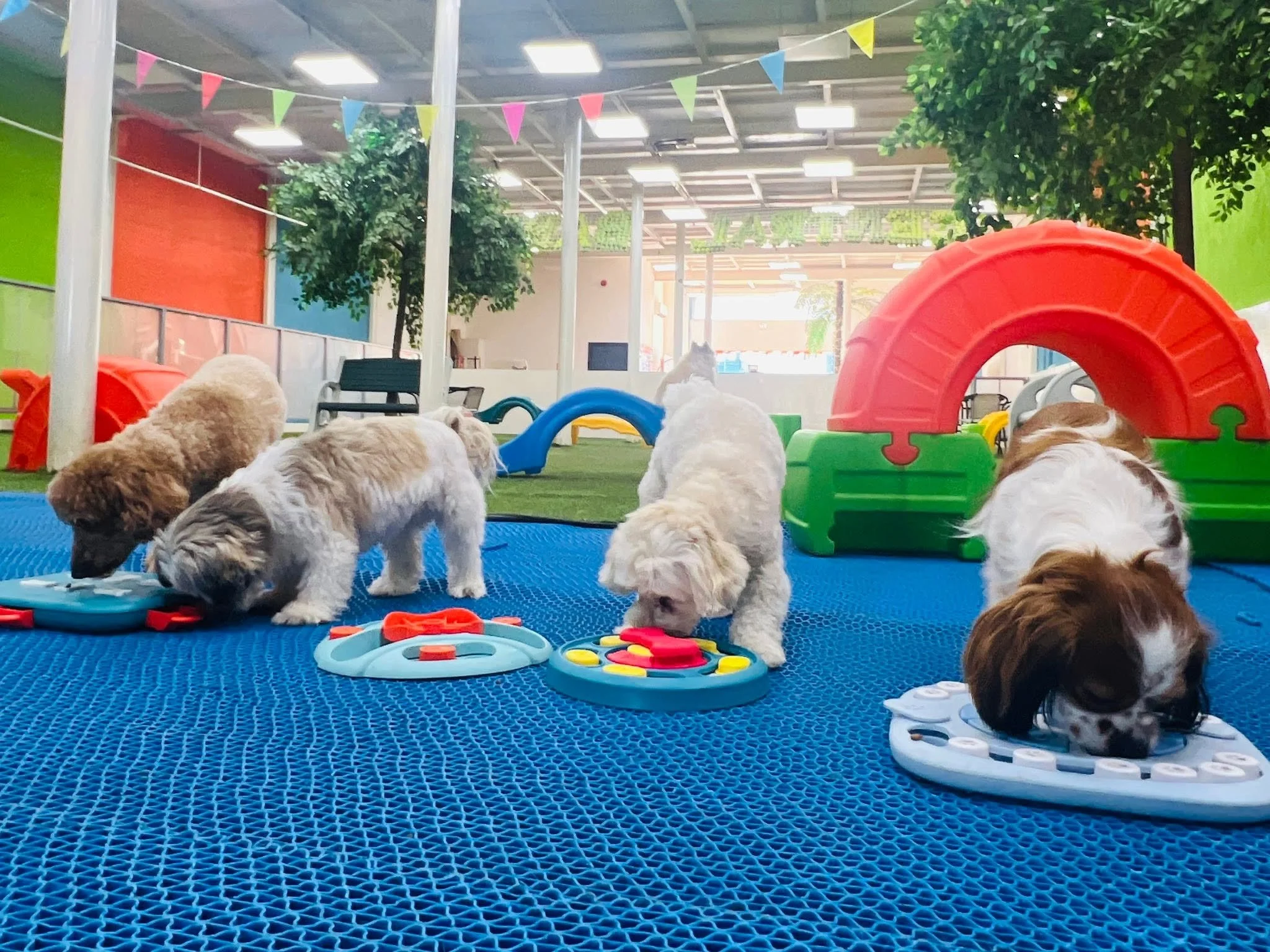
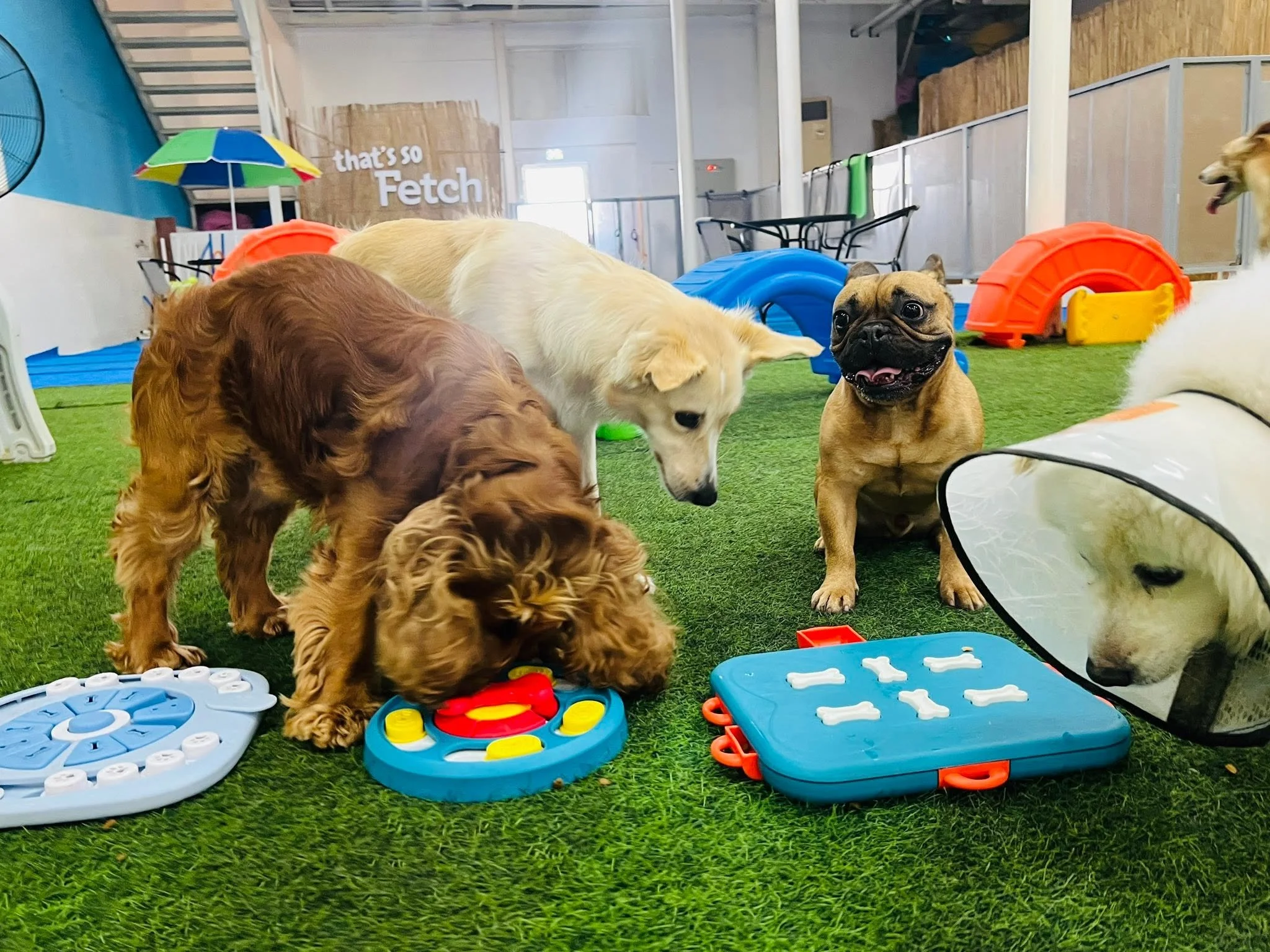
At Fetch, we use treats actively throughout the day as part of our enrichment and reinforcement approach, at the same time our injury incident as a result of aggression rate to date is near zero year on year. That means we are genuinely managing for resource guarding in its full complexity, not sidestepping it. This has taken years of being risk averse and taking hard stances against quick and easy. A dog who guards around food or high-value treats requires real assessment and real management from us, continued and sustained reassessment of our procedures and systems before making assumptions or siding with blame, and we make that decision honestly at intake, not after the first incident in the group.
The honest question to ask any daycare
Ask them directly: how do you manage resource guarding? If the answer is that they do not have resources in the group so it is not an issue, that tells you they have not thought past the most obvious trigger. A facility that can describe their spatial management, their staff monitoring practices, and their intake assessment for guarding behaviour is one that has actually engaged with the problem.
If you are unsure whether your dog's guarding history affects their suitability for daycare, contact us. We would rather have that conversation upfront than discover mid-session that a dog was placed in an environment that was not prepared for them.
References
Jacobs, J.A., Coe, J.B., Pearl, D.L., Widowski, T.M. & Niel, L. (2018a). Factors associated with canine resource guarding behaviour in the presence of people: A cross-sectional survey of dog owners. Preventive Veterinary Medicine, 161, 143–153. https://doi.org/10.1016/j.prevetmed.2017.02.005
Jacobs, J.A., Coe, J.B., Pearl, D.L., Widowski, T.M. & Niel, L. (2018b). Factors associated with canine resource guarding behaviour in the presence of dogs: A cross-sectional survey of dog owners. Preventive Veterinary Medicine, 161, 134–142. https://doi.org/10.1016/j.prevetmed.2017.02.004
Jacobs, J.A., Coe, J.B., Widowski, T.M., Pearl, D.L. & Niel, L. (2018c). Defining and clarifying the terms canine possessive aggression and resource guarding: a study of expert opinion. Frontiers in Veterinary Science, 5, 115. https://doi.org/10.3389/fvets.2018.00115
Jacobs, J.A., Pearl, D.L., Coe, J.B., Widowski, T.M. & Niel, L. (2017). Ability of owners to identify resource guarding behaviour in the domestic dog. Applied Animal Behaviour Science, 188, 77–83. https://doi.org/10.1016/j.applanim.2016.12.012